






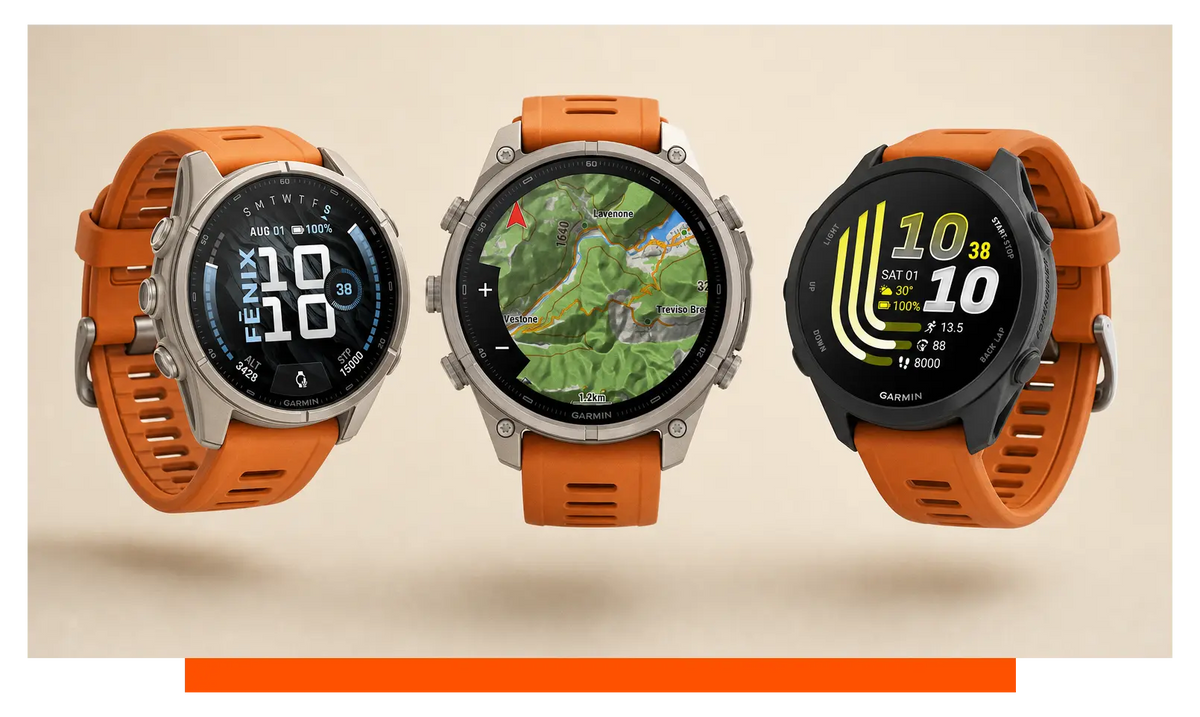
Choose by how long you will wear it and where you train: a Forerunner is the comfortable everyday running pick, Fenix 9 covers rugged multisport, Enduro 4 is built for very long outdoor efforts, and Fenix 9 Pro adds connected safety. Enduro 4 is not on sale yet.
| Watch | Best for | Case size | Battery headline | Navigation | Price at the time of writing |
|---|---|---|---|---|---|
| Garmin Fenix 9 | rugged multisport | 43 mm, 47 mm, 51 mm | Up to 29 days in smartwatch mode | Routable maps | £859.99 / £859.99 / £949.99 |
| Garmin Fenix 9 Pro | remote training with connected safety | 43 mm, 47 mm, 51 mm | Up to 57 days in smartwatch mode | Outdoor Maps+ | £949.99 / £949.99 / £1,029.99 |
| Garmin Forerunner 170 | everyday running | 42.6 mm | Up to 20 hours with GPS | Breadcrumb navigation | £259.99 |
| Garmin Forerunner 70 | straightforward run tracking | 42.6 mm | Up to 23 hours with GPS | Breadcrumb navigation | £219.99 |
| Garmin Enduro 4 | long outdoor efforts | 51 mm | Up to 320 hours with solar | TopoActive maps | £799.99 |
The deciding factor is whether you want all-day, sleep-friendly comfort or a larger watch designed to keep tracking through long, remote outdoor sessions.
Which latest Garmin is right for your training?
Forerunner suits regular running and daily wear, Fenix suits mixed training and outdoor navigation, Enduro prioritises endurance, and Fenix Pro is the specialist choice when connected safety away from your phone matters.
Garmin Forerunner 170: this is the balanced everyday running model. You get Garmin Coach, an AMOLED touchscreen, breadcrumb navigation, a barometric altimeter and Garmin Pay without carrying a rugged outdoor case through work and sleep. Its 41 g weight is the clearest wrist-level advantage here. The standard model lacks onboard music, although Garmin sells a separate Music version.
Garmin Forerunner 70: this is the simpler runner’s watch. It weighs 40 g, supports Garmin Coach and gives you longer quoted GPS tracking than the Forerunner 170. You give up Garmin Pay, the barometric altimeter, onboard music and some additional cycling metrics. If you mainly want pace, distance and structured coaching, those omissions may not affect your training.
Garmin Fenix 9: choose this for advanced training, offline routable maps and a built-in LED flashlight in a watch intended to handle running, hiking and wider multisport use. It also stores music and includes a speaker and microphone. The trade-off is straightforward: even the smaller case belongs to a more substantial watch family than either Forerunner.
Garmin Fenix 9 Pro: this adds LTE and satellite functions through Garmin’s inReach system, plus Outdoor Maps+. Select versions also offer solar charging. It makes sense when you train beyond dependable phone coverage and will maintain the required plan; for ordinary urban runs, the standard Fenix gives you the core training and mapping experience without paying for that extra safety layer.
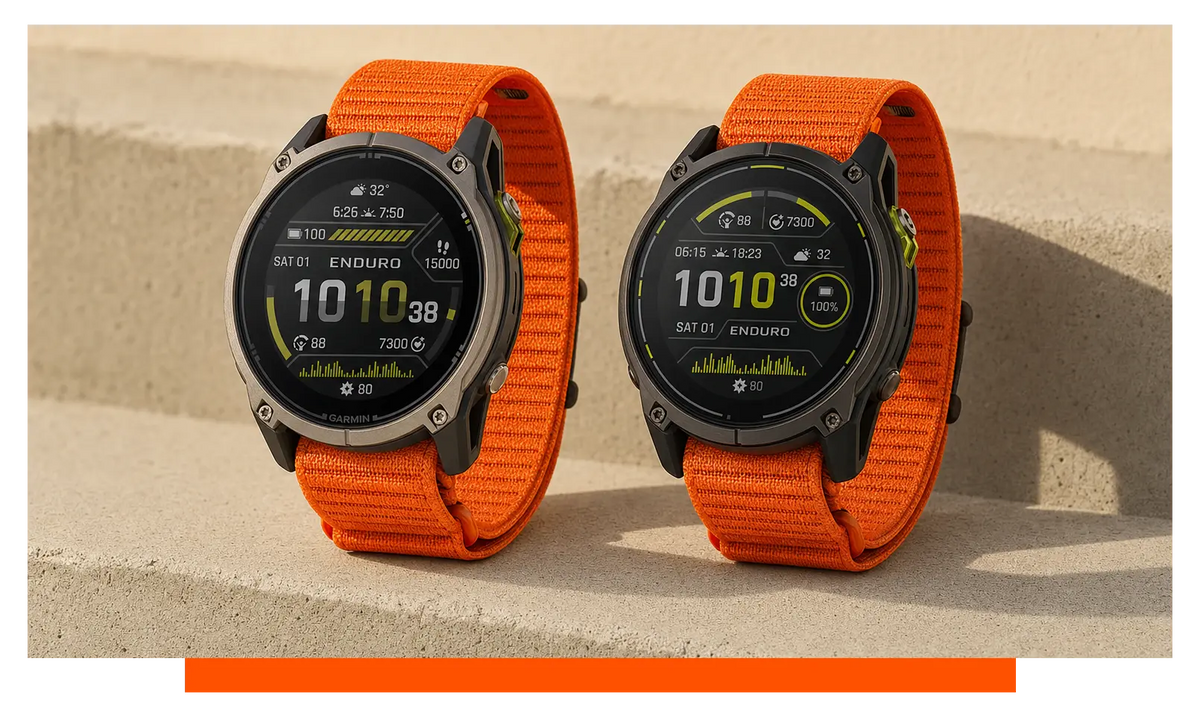
Garmin Enduro 4: this is built around long-distance outdoor tracking, a sunlight-visible MIP display, solar charging and TopoActive maps. It is also firmly a large-case watch. Garmin has scheduled availability from 3 November 2026, so it remains a future purchase rather than a watch you can take home at the time of writing.
Comfort, case size and strap fit
The Forerunners are the safest choices for sleep and everyday comfort, while the Fenix size options let you balance screen presence against wrist bulk; Enduro offers no smaller-case escape route.
The Forerunner 170 and Forerunner 70 share a 42.6 mm case and use quick-release 20 mm straps. That combination is practical if you want to loosen the fit after a sweaty session or swap to something less sporty for work. Silicone, nylon, leather, milanese and metal options are available among our Garmin Forerunner 170 straps and Garmin Forerunner 70 straps.
With the Fenix 9, strap width follows the case: the 43 mm model takes 20 mm straps, the 47 mm model takes 22 mm straps and the 51 mm model takes 26 mm straps. That detail matters before ordering a replacement. The middle size has the broadest all-round feel, with silicone, nylon, leather, milanese and metal available among our Garmin Fenix 9-47mm straps.
Enduro 4 uses 26 mm straps, matching its large outdoor-focused case. Silicone, nylon, leather, milanese and metal options are available among our Garmin Enduro 4 straps, but changing the material cannot make a large case feel small. If it catches on sleeves or disturbs your sleep, that is a watch-size problem rather than a strap problem.
Battery life, maps and connected safety
Enduro 4 is the battery choice for prolonged GPS use, Fenix is the mapping choice for mixed outdoor training, and the Forerunners cover ordinary running without the bulk of either.
Forerunner 170 is rated for up to 10 days in smartwatch mode and up to 20 hours with GPS. Forerunner 70 extends those quoted limits to up to 13 days and up to 23 hours. That makes either suitable for routine training, but Enduro 4 changes the scale: it is rated for up to 90 days in smartwatch mode and up to 320 hours with solar.
The navigation split is just as important. Breadcrumb guidance on the Forerunners can keep you following a prepared line, but it is not an offline map. Fenix 9 and Fenix 9 Pro provide proper on-watch mapping, while Enduro 4 adds multicontinent TopoActive maps, dynamic round-trip routing, NextFork guidance and turn-by-turn courses.
Connected safety is narrower than the hardware name suggests. The Fenix 9 Pro’s LTE and satellite tools depend on an active inReach plan, supported coverage and the particular feature you are trying to use. They are valuable for the right trip, but they do not turn the watch into an unrestricted satellite phone.
Where the published limits can mislead
Battery claims are maximums, not a promise for every wrist. Display use, navigation, music, satellite communication and available sunlight can all shorten the interval between charges. Solar-assisted Enduro figures are therefore most relevant to someone who actually spends long periods outside.
Maps cannot tell you whether a path is temporarily closed, safe in current weather or suitable for your ability. Connected features cannot guarantee coverage everywhere, either. Treat them as planning and safety aids, not replacements for route knowledge, suitable equipment or an emergency plan.
Who each Garmin is - and is not - for
The range works best when you buy for your normal week rather than the most ambitious trip you might take once.
Who these watches are for
- Forerunner 170: runners who want a light sleep-friendly watch, payments and more training context.
- Forerunner 70: newer runners who value straightforward coaching and GPS endurance over music or payments.
- Fenix 9: multisport athletes and hikers who will regularly use offline maps, music and the flashlight.
- Fenix 9 Pro: outdoor users who need supported LTE or satellite safety features away from their phone.
- Enduro 4: ultra-distance runners, expedition users and others who spend prolonged periods away from charging.
Who they are not for
- Forerunner models: people who need detailed offline maps directly on the wrist.
- Fenix models: sleepers or smaller-wristed runners who already find rugged watches intrusive.
- Fenix 9 Pro: buyers who train within phone coverage and would not maintain an inReach plan.
- Enduro 4: casual runners who would carry its large case without using its exceptional outdoor endurance.
- Any model here: someone expecting maps or connectivity to replace preparation in remote terrain.
Start with comfort and time away from a charger, and the latest Garmin range becomes much easier to narrow down.
Frequently asked questions
Which Fenix 9 Pro features work in my country?
LTE functions require a supported LTE-M coverage area, while satellite messaging, check-ins and satellite weather cover the continental United States, select parts of Canada and most of Europe. SOS, LTE and satellite functions require an active inReach plan, so check Garmin’s coverage map for your destination.
Does a Fenix 9 strap fit Fenix 9 Pro?
Yes, when the case sizes match: 43 mm uses 20 mm straps, 47 mm uses 22 mm straps and 51 mm uses 26 mm straps. For the middle size, browse Garmin Fenix 9 Pro - 47mm straps.
Which strap material is best for sweaty running?
Silicone is the practical choice when you train hard because it can be rinsed regularly after sweaty workouts. It is available for every Garmin watch covered here.


Leave a comment
All comments are moderated before being published.
This site is protected by hCaptcha and the hCaptcha Privacy Policy and Terms of Service apply.