


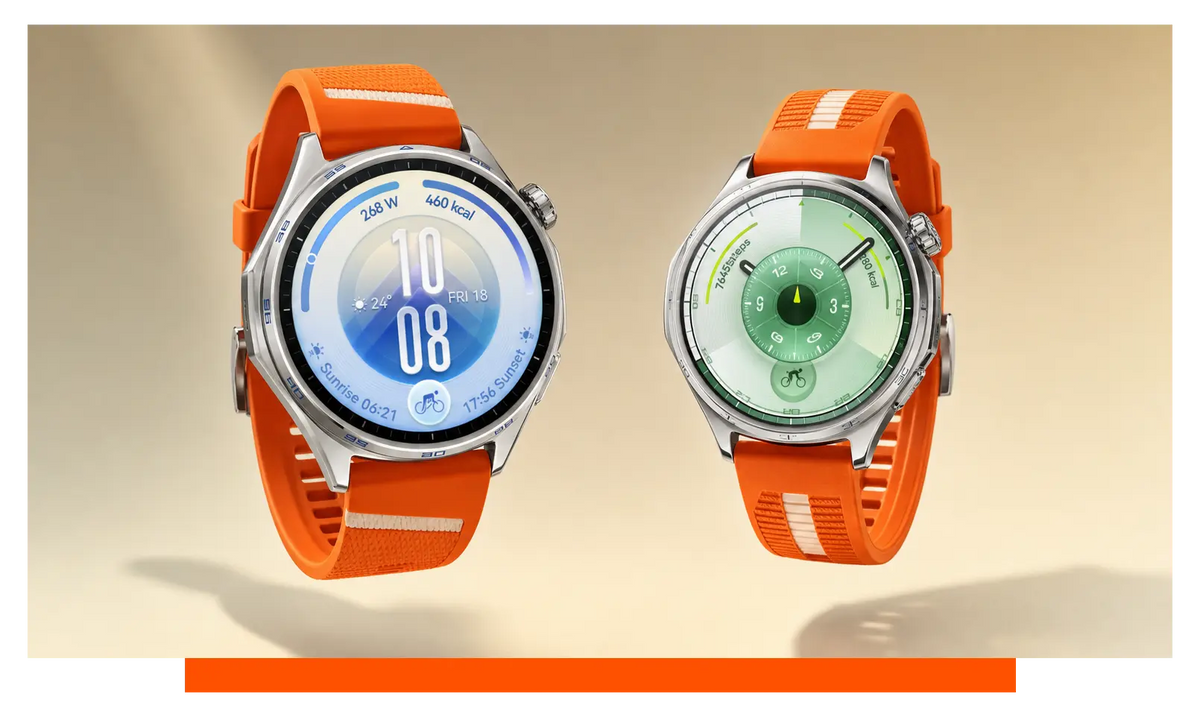
Buy the Huawei Watch GT 7 if long GPS hikes, rides, trail runs or snow sports are a regular part of your week; its longer workout endurance and newer outdoor tools matter there. Buy the Huawei Watch GT 6 if value matters more. For everyday training, battery routine, screen and fit, they are remarkably close.
The short version
The Huawei Watch GT 7 is the stronger outdoor-training watch, while the Huawei Watch GT 6 preserves most of the everyday experience at a lower street price.
- Long GPS sessions: the Huawei Watch GT 7 quotes up to 51 hours of trail running in the 46 mm size and 32 hours in the 41 mm size. The Huawei Watch GT 6 quotes 40 hours and 25 hours respectively for outdoor sport.
- Everyday battery: there is no quoted advantage. Both generations offer 21/14 days in light use, 12/7 days in typical use and 7/5 days with the always-on display, with the larger case listed first.
- Outdoor software: the Huawei Watch GT 7 adds broader skiing tools and downloadable ski resort maps. That is meaningful for snow sports, but less important for gym sessions and ordinary runs.
- Price: at the time of writing, the Huawei Watch GT 7 is £279 in 41 mm and £279 in 46 mm; the Huawei Watch GT 6 is £199.99 and £199.99 respectively.
- Fit: both come in 46 mm and 41 mm cases, and both accept widely available 22mm quick-release straps. You do not need to choose the newer watch to get the better fit.
The deciding trade is simple: GT 7 gives you more recording time and newer tools for demanding outdoor sessions; GT 6 gives you nearly the same daily wrist experience for less.
Huawei Watch GT 7 and Huawei Watch GT 6 specifications compared
The biggest specifications gap is GPS workout endurance; most of the hardware you see and use every day is shared.
| Specification | Huawei Watch GT 7 | Huawei Watch GT 6 |
|---|---|---|
| GPS workout endurance | 51 hours trail running / 32 hours trail running | 40 hours outdoor sport / 25 hours outdoor sport |
| Price | £279 / £279 | £199.99 / £199.99 |
| Sports tracking | 110+ workout modes | 100+ sports modes |
| Outdoor sports tools | Skiing & Cycling Modes | Wrist-based Cycling Power |
| Battery life | 21/14 days light; 12/7 typical; 7/5 AOD | 21/14 days light; 12/7 typical; 7/5 AOD |
| Peak brightness | 3,000 nits | 3,000 nits |
| Display | 1.47 / 1.32 inches AMOLED | 1.47 / 1.32 inches AMOLED |
| Display resolution | 466 × 466 pixels | 466 × 466 pixels |
| GNSS | Dual-band GNSS | Dual-band GNSS |
| Case sizes | 46 mm / 41 mm | 46 mm / 41 mm |
| Case material | Stainless steel | Stainless steel |
| Platform | HarmonyOS | HarmonyOS |
| Bluetooth | BT6.0 | BT6.0 |
| NFC | Yes | Yes |
| Bluetooth calling | Yes | Yes |
| Charging | Wireless charging | Wireless charging |
| Water resistance | 5 ATM / IP69 | 5 ATM / IP69 |
| Optical heart-rate sensor | Yes | Yes |
In practical terms, you are trading the GT 6’s lower price for the GT 7’s longer outdoor recording window and more developed snow-sport support.
Huawei Watch GT 7 vs Watch GT 6: GPS battery life
The Huawei Watch GT 7 is meaningfully better when a recorded outdoor activity is likely to continue through most of a day or beyond it.
Huawei quotes up to 51 hours of trail running for the 46 mm GT 7 and 32 hours for the 41 mm model. The corresponding GT 6 figures are up to 40 hours of outdoor sport for the 46 mm watch and 25 hours for the 41 mm version.
That gap matters most if you record long hikes, endurance rides, trail events or weekends where stopping to charge would be inconvenient. It also gives you more breathing room when navigation, regular screen checks and notifications are all part of the outing. Published maximums are not promises for every combination of settings, but the GT 7 starts with the larger allowance.
Shorter sessions change the calculation. If you run before work, record a gym class or cycle for part of the day, both watches have ample quoted endurance. The GT 7’s advantage can remain unused, which makes the discounted GT 6 much easier to justify.
On your wrist, the difference appears as less battery planning before a genuinely long route - not as a dramatic change during an ordinary workout.
Outdoor sports and workout tracking
The Huawei Watch GT 7 has the broader sports package, especially if skiing or route-led outdoor training sits high on your list.
It offers 110+ workout modes against 100+ sports modes on the GT 6. The raw total is not the important part: most buyers repeatedly use a small group of activities. What matters is whether your activity is among the areas Huawei has developed further.
Snow sports provide the clearest reason to favour the newer watch. GT 7 adds indoor snow sports and downloadable ski resort maps, giving skiers a practical tool rather than merely another item in a long mode list. If you visit ski resorts regularly, that can remove a real limitation. If you never ski, it should not influence the purchase.
Cyclists should look beyond the mode count as well. GT 7 highlights its newer skiing and cycling modes, while GT 6 includes wrist-based cycling power. Your choice should follow the training information you will actually use, not the watch with the longer menu.
What you would notice is greater scope on the GT 7 for specialised outdoor days; familiar everyday workouts remain a close contest.
Should you pay more for the Huawei Watch GT 7?
You should pay more for the Huawei Watch GT 7 only when its longer GPS endurance or snow-sport additions solve a problem you genuinely have.
At the time of writing, the 41 mm Huawei Watch GT 7 is £279, while the 46 mm Huawei Watch GT 7 is £279. The 41 mm Huawei Watch GT 6 is £199.99, and the 46 mm Huawei Watch GT 6 is £199.99.
The lower-priced GT 6 is particularly convincing for daily activity tracking, sleep wear, commuting and regular workouts. Its display specification, routine battery claims, navigation hardware, case options and core smartwatch functions line up closely with those of the GT 7. Paying more does not make those shared elements feel new.
GT 7 earns its premium in a narrower but credible way. An endurance athlete can use the extra recording allowance. A skier can use the expanded snow tools. Someone buying mainly for steps, calls, heart-rate tracking and ordinary exercise may never reach the point where the premium pays back.
In daily use, your bank balance is more likely to register the difference than your wrist unless long outdoor recording is part of your routine.
Huawei Watch GT 7 vs Watch GT 6: display
The displays are effectively level on the supplied specifications, so screen quality is not a reason to pay extra for the Huawei Watch GT 7.
Both generations pair a 1.47-inch AMOLED screen with the 46 mm case and a 1.32-inch AMOLED screen with the 41 mm case. Resolution is 466 × 466 pixels across the range, while peak brightness is listed at 3,000 nits.
That brightness figure matters outdoors: either watch is built to remain readable when you glance at pace, distance or directions in strong daylight. The shared resolution also means you are not giving up a sharper interface by choosing the GT 6.
Case size has more effect on the display experience than watch generation. The larger screen gives workout fields and maps more room, which is useful while moving. The smaller screen is less dominant on a narrow wrist and may be more comfortable overnight.
At a glance, you would notice the contrast between the two case sizes before spotting any generational difference.
Case size, comfort and straps
Fit is a draw between the Huawei Watch GT 7 and GT 6 because both offer the same case-size choice and the same practical strap fitting.
The 41 mm versions are designed for wrists from 120 mm, while the 46 mm models start at 140 mm. That gives smaller wrists a clear place to begin: the 41 mm case is less likely to overhang and is usually the more natural option for sleep tracking. Choose the 46 mm watch when you value the larger display and battery allowance and your wrist can support it comfortably.
Both generations use 22mm wide (46mm) or 18mm wide (41mm) quick-release straps. That shared fitting is useful if you already own a GT 6 and are considering a GT 7, because a suitable existing strap can move across rather than being discarded.
Changing your strap is easy. For both Huawei Watch GT 7 46 mm straps and Huawei Watch GT 7 41 mm straps, we stock silicone, nylon, leather, milanese and metal options. The Huawei Watch GT 6 46 mm strap and Huawei Watch GT 6 41 mm strap ranges cover those materials and titanium as well.
Silicone suits sweaty sessions and wet weather. Nylon can soften the feel for long wear, while leather, milanese and metal make more sense when the watch needs to move from training to work without looking overtly sporty.
After a full day, the case size and strap material will affect comfort far more than the GT number on the box.
Everyday battery life
Everyday battery life is a tie, despite the Huawei Watch GT 7’s clear advantage during continuous GPS activity.
Huawei gives both generations the same quoted routine: 21 days for the larger model and 14 days for the smaller model under light use; 12 days and 7 days under typical use; and 7 days and 5 days with the always-on display enabled.
This distinction is central to the comparison. GT 7 extends the recording window for demanding outdoor sessions, but it does not promise a longer gap between charges for ordinary mixed use. If your week consists of notifications, sleep tracking and shorter workouts, the GT 6 follows the same charging rhythm on paper.
The always-on display is the setting most likely to shape that routine. It makes the time immediately visible, but the quoted battery claims show the cost. Buyers prioritising endurance can use raise-to-wake instead; those treating the watch as a traditional timepiece may accept more frequent charging.
Away from long GPS activities, you should expect the case size and display setting - not the generation - to govern how often you reach for the charger.
Huawei Watch GT 7 vs Watch GT 6: GPS and maps
Both watches have capable dual-band GNSS and offline mapping, but the Huawei Watch GT 7 has the more useful map package for skiers.
Dual-band GNSS is valuable when terrain, trees or tall buildings make satellite reception difficult. It is intended to produce a steadier recorded route than a more basic positioning setup, helping mapped corners and distance totals better reflect where you travelled. Because both watches include it, runners and cyclists do not need the GT 7 merely to gain the underlying positioning hardware.
Both also support offline maps. GT 6 covers offline maps for running and navigation for everyday rides, so it remains a practical choice when you want directions without constantly consulting your phone. GT 7 adds downloadable ski resort maps, which aligns with its broader snow-sport focus.
The deciding question is where you navigate. On familiar roads and running routes, the shared hardware keeps the watches close. At a ski resort, GT 7 supplies the more relevant map option.
Mid-route, that means similar location support for everyday runs and rides, with a specific GT 7 advantage once your route moves onto the slopes.
Calls, music and smartwatch features
The core smartwatch package is closely matched, so neither watch wins this comparison through calls, connectivity or the basic platform.
Both run HarmonyOS, use BT6.0 and support Bluetooth calling, NFC and music playback. You can therefore answer a call from your wrist when your phone is connected, and either watch can play music that has been transferred for offline listening.
This is useful for commuting and training, but these are not independent mobile watches. Phone pairing and app support still shape what you can do, particularly around message replies and music transfer. Check the feature you care about against the phone you use rather than assuming every function behaves identically on every handset.
For most owners, the practical experience is the same: either generation can handle a call or supply stored workout music, leaving outdoor endurance as the stronger reason to choose GT 7.
Sensors, water resistance and health hardware
The standard Huawei Watch GT 7 and GT 6 share the health hardware established here, with neither gaining an advantage in optical heart-rate sensing or water-resistance ratings.
Both include an optical heart-rate sensor and both are rated at 5 ATM / IP69. That supports the normal mix of exercise tracking, wet-weather training and daily wear expected from this type of sports watch.
Neither standard model includes an ECG sensor. That distinction matters if ECG is on your buying checklist: it is a reason to consider a Pro model, not a reason to choose GT 7 over GT 6 in this standard-model comparison.
The matched hardware also keeps the value argument intact. If heart-rate monitoring is your main priority and you do not require Pro-only equipment, GT 6 does not surrender the listed sensor to reach its lower price.
During an ordinary week, you gain the same core wrist sensor and resistance ratings; GT 7’s meaningful lead still appears outdoors over longer sessions.
Charging and ownership routine
Charging is another draw because both Huawei watches use wireless charging and carry the same quoted everyday battery schedules.
That makes switching generations straightforward. There is no fundamentally different charging habit to learn, and the GT 7 does not ask you to accept shorter routine endurance in exchange for its longer GPS recording claim.
Before a long event, GT 7 gives you the more forgiving starting point once continuous tracking begins. During a typical working week, however, both watches should fit a similar top-up pattern based on the case size and whether the always-on display is active.
You would feel the GT 7 advantage while planning an endurance outing, not while charging after a normal run.
Where Huawei Watch GT 7 is better
The Huawei Watch GT 7 wins where continuous outdoor recording and specialised sports support carry real value.
- Longer trail-running endurance: up to 51 hours in 46 mm and 32 hours in 41 mm.
- More workout choices: 110+ workout modes.
- Stronger snow-sport support: indoor snow sports and downloadable ski resort maps.
- Better endurance-event margin: more quoted recording time for long hikes, rides and trail sessions.
Where Huawei Watch GT 6 is better
The Huawei Watch GT 6 wins on value and remains the more rational purchase when the GT 7’s outdoor additions would sit unused.
- Lower price: £199.99 in 41 mm and £199.99 in 46 mm at the time of writing.
- Same routine battery claims: 21/14 days light, 12/7 days typical and 7/5 days with AOD.
- Same display specification: 3,000 nits and 466 × 466 pixels in either case size.
- Broader catalogue material choice: silicone, nylon, leather, milanese, metal and titanium straps.
- Wrist-based cycling power: a specific tool that may matter more than the GT 7’s higher workout-mode total.
Who should choose which
Choose according to the length and type of activity you record, because ordinary watch use does not create a large gap between these generations.
- Choose Huawei Watch GT 7 if you regularly record long hikes, rides or endurance events and want the larger GPS battery allowance.
- Choose Huawei Watch GT 7 if you ski and will use indoor snow-sport tracking or downloadable resort maps.
- Choose Huawei Watch GT 6 if it is meaningfully discounted and your workouts normally finish well inside its quoted outdoor endurance.
- Choose Huawei Watch GT 6 if you mainly want daily tracking, calls, music and a bright display without paying for specialised additions.
- Choose the 41 mm version of either watch if you have a small wrist or prioritise sleep comfort; consider 46 mm when screen space and the larger battery allowance matter more.
- Consider a different Huawei format if you want a lighter fitness-led design; our Huawei Band 11 versus Watch Fit 5 comparison explains the alternative.
In short, GT 7 is the outdoor-endurance upgrade; GT 6 is the value choice for almost everything else covered here.
Frequently asked questions
These answers cover the ownership and compatibility details that can change the decision after the core comparison.
Is the Huawei Watch GT 7 worth upgrading to from a Huawei Watch GT 6 I already own?
Upgrade if you need indoor snow sports, downloadable ski resort maps or longer trail-running battery life: GT 7 quotes up to 51 hours in 46 mm and 32 hours in 41 mm, against 40 hours and 25 hours for GT 6. Keep the GT 6 if those are not priorities, because the quoted everyday battery routines match.
Does either watch work well with an iPhone?
Yes, if your iPhone runs iOS 13.0 or later, both watches pair through Huawei Health. Feature availability can vary by phone model and operating system, so check any feature essential to you before buying.
Can I reply to messages and take Bluetooth calls on both watches?
Yes, with an Android phone both watches can reply to SMS and supported app messages as well as take Bluetooth calls. With an iPhone, calls are supported but message replies are not.
Do both watches support music without carrying a phone?
Yes, if you transfer music through an Android phone, either watch can play the synced tracks without an internet connection.
Should I choose the standard model or the Pro version instead?
Choose Pro if ECG, a titanium case or diving to 40 metres matters to you. Choose the standard watch if you want the 41 mm option or the core sleep, heart-rate, blood-oxygen, maps, calls and music features without Pro-only hardware.




Leave a comment
All comments are moderated before being published.
This site is protected by hCaptcha and the hCaptcha Privacy Policy and Terms of Service apply.