


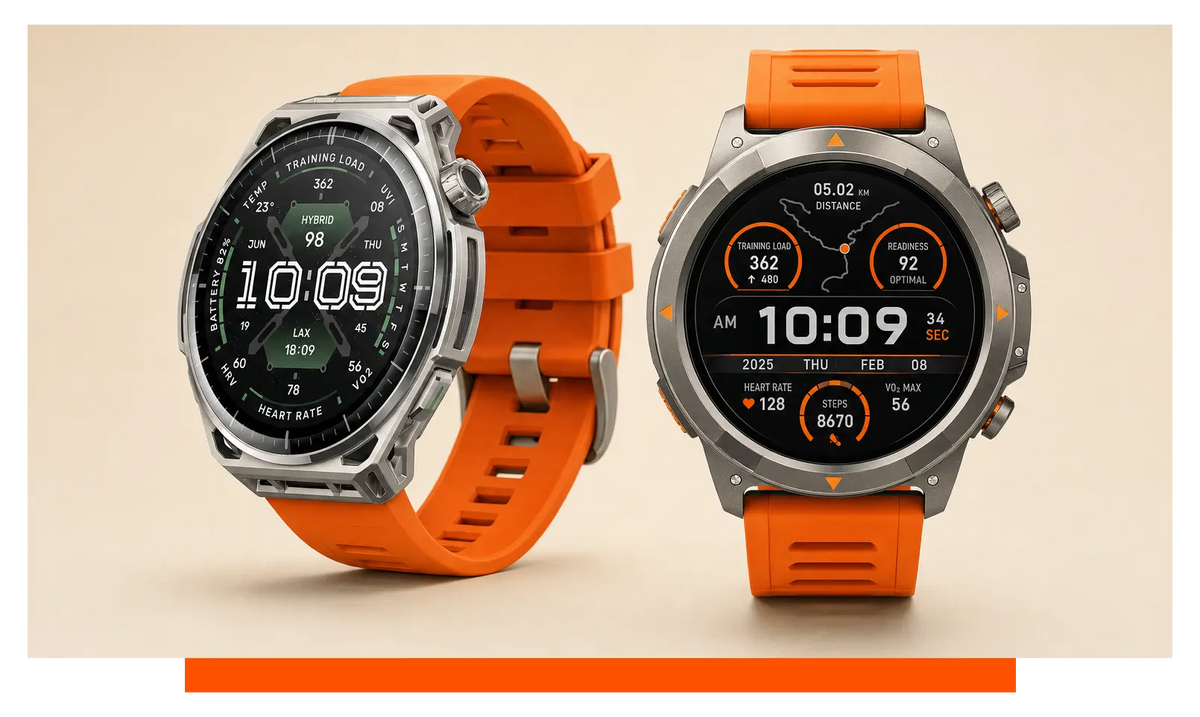
Garmin Fenix 9 is the better dedicated training watch for endurance athletes, while Apple Watch Ultra 4 better suits iPhone users who want serious workout tools in a more capable everyday smartwatch. The deciding factor is simple: whether your longest races, training days and trips can tolerate frequent charging.
On this page
You can jump straight to the part of the comparison that matters most to your training.
- The short version
- Apple Watch Ultra 4 and Garmin Fenix 9 specifications compared
- Apple Watch Ultra 4 vs Garmin Fenix 9: battery life
- Can Apple Watch Ultra 4 replace Garmin Fenix 9 for structured training?
- Garmin Fenix 9 vs Apple Watch Ultra 4: navigation and maps
- Phone compatibility and everyday smartwatch features
- Case size, strap choice and overnight comfort
- Sleep and recovery insights
- GPS accuracy and display quality
- Swimming, water resistance and diving
- Storage, payments and phone-free use
- Apple Watch Ultra 4 vs Garmin Fenix 9: price
- Where Apple Watch Ultra 4 is better
- Where Garmin Fenix 9 is better
- Who should choose which
- Frequently asked questions
The short version
Garmin Fenix 9 wins for long, structured and outdoor training, but Apple Watch Ultra 4 is easier to live with if your watch also needs to act as an extension of your iPhone.
- Choose Garmin Fenix 9 for endurance: its larger versions extend GPS workout tracking well beyond the Apple watch, reducing the risk that a long race or expedition becomes a charging problem.
- Choose Apple Watch Ultra 4 for connected convenience: cellular connectivity, Apple Pay and close iPhone integration make calls, messages, apps and everyday errands feel more natural away from your handset.
- Garmin offers more fit choices: the three case sizes let you balance screen presence, weight and battery life instead of accepting one large case.
- Both provide serious training foundations: each offers dual-frequency or multi-band positioning, offline mapping, recovery guidance and a sapphire display surface.
- Android decides the comparison immediately: Garmin Fenix 9 works with iPhone and Android, whereas Apple Watch Ultra 4 requires a compatible iPhone.
- Apple costs less at the time of writing: Apple Watch Ultra 4 is listed at £749, while Garmin Fenix 9 pricing starts with the smaller case at £859.99.
The central trade is long-session independence against iPhone-first convenience.
Apple Watch Ultra 4 and Garmin Fenix 9 specifications compared
The specifications favour Garmin Fenix 9 when battery endurance and fit choice come first, while Apple Watch Ultra 4 concentrates its advantage in cellular use and everyday iPhone integration.
| Specification | Apple Watch Ultra 4 | Garmin Fenix 9 |
|---|---|---|
| GPS workout battery life | Up to 18 hours | 43mm: up to 18 hours; 47mm: up to 30 hours; 51mm: up to 54 hours |
| Training guidance | Readiness | Training Readiness |
| Navigation and maps | Offline maps | TopoActive maps |
| Phone compatibility | iPhone 11 or later; iOS 27 or later | iPhone; Android |
| Case size and weight | 49mm; 63.0-63.1g | 43mm, 47mm or 51mm; 61-91g |
| Sleep and recovery insights | Sleep score; Recovery HRV | Sleep score; Training Readiness |
| Cellular connectivity | 5G; LTE | No |
| Smartwatch battery life | Up to 50 hours | 43mm: up to 10 days; 47mm: up to 16 days; 51mm: up to 29 days |
| Price at the time of writing | £749 | 47mm: £859.99 |
| Device category | Smartwatch | Premium multisport GPS smartwatch |
| Display technology | Always-On Retina LTPO3 OLED | AMOLED |
| Display resolution | 422 x 514 pixels | 416 x 416 or 454 x 454 pixels |
| Storage capacity | 64GB | 64GB |
| GPS | Precision dual-frequency GPS | Multi-band GPS |
| Water resistance | 100 metres | 10 ATM |
| Dive depth | 40m | 40m |
| Display lens | Flat sapphire crystal display | Sapphire lens |
| Contactless payments | Apple Pay | Garmin Pay |
| Voice assistant | Siri AI | Voice assistant |
| Speaker and microphone | Yes | Yes |
Many of the core capabilities overlap. What changes the buying decision is how long each watch can keep recording when a workout stops looking like an ordinary gym session and turns into an all-day effort.
Apple Watch Ultra 4 vs Garmin Fenix 9: battery life
Garmin Fenix 9 is the clear battery winner, particularly in its larger case sizes.
Apple Watch Ultra 4 is rated for up to 18 hours of GPS workout use. That is substantial enough for daily running, cycling, hiking and most organised events, and it removes the battery anxiety associated with less endurance-focused smartwatches. It does not, however, give you the same margin for delays, navigation, cold weather or a second activity before you reach a charger.
The smallest Garmin Fenix 9 matches that up-to-18-hour GPS rating. The middle case raises it to up to 30 hours, while the largest reaches up to 54 hours. Those are not merely specification-sheet victories. They let an ultrarunner record through the night, give a hiker more room for route changes and allow a travelling athlete to train without making a charging cable part of every day’s plan.
The everyday figures tell the same story. Apple Watch Ultra 4 is rated for up to 50 hours of smartwatch use. Depending on case size, Garmin Fenix 9 is rated for up to 10 days, 16 days or 29 days. Garmin therefore fits better around training camps, multi-day walking trips and busy weeks when remembering another device charger is an irritation.
Battery life still depends on how you use GPS, maps, music and connected features, so the maximum is not a promise for every session. Yet the gap is large enough to shape behaviour: with Garmin’s larger cases, you are less likely to check the battery before committing to a long route.
Can Apple Watch Ultra 4 replace Garmin Fenix 9 for structured training?
Apple Watch Ultra 4 can replace Garmin Fenix 9 for many structured training plans, but Garmin remains the more purpose-built option for athletes who want training guidance to sit at the centre of the watch.
Apple now covers the essentials far more convincingly than a simple activity smartwatch. Readiness turns recent training and recovery information into a usable daily signal, while the Workout app supports goal-led sessions and the alerts needed to follow intervals without constantly looking at the screen. If you train several times a week and already organise your life through an iPhone, it can provide enough structure without making the watch feel like specialist equipment outside exercise.
Garmin’s Training Readiness sits within a broader multisport mindset. The Fenix interface is built around starting an activity, reading physical buttons during movement, reviewing training status and preparing for the next session. That focus matters most when your week mixes long runs, rides, swimming, strength work and outdoor sessions rather than repeating one familiar workout.
Neither watch can do the training for you, and a readiness score should not overrule illness, pain or plain fatigue. The practical difference is emphasis. Apple gives you capable training tools inside an excellent smartwatch; Garmin gives you a training watch that also handles everyday connected tasks.
You would notice Garmin’s advantage most during a dense training block, when the watch is being used to plan, execute and review sessions rather than simply record them.
Garmin Fenix 9 vs Apple Watch Ultra 4: navigation and maps
Garmin Fenix 9 is the stronger navigation tool for serious outdoor use, although Apple Watch Ultra 4 can still guide you without a live phone connection.
Apple provides offline maps, which makes the Ultra useful for running, walking or exploring where mobile reception is unreliable. Its bright, touch-led interface is approachable when you want to inspect your surroundings quickly, and the wider smartwatch app ecosystem gives you more ways to tailor navigation around a particular activity.
Garmin’s TopoActive maps are more naturally tied into an outdoor training workflow. The watch is designed for routes, courses and navigation information to remain part of the exercise screen rather than feeling like a separate phone-style task. Physical controls are useful with gloves, rain or sweaty hands, especially when touch input becomes awkward.
This is not a claim that Apple cannot handle a planned trail route. It can. Garmin simply asks for fewer compromises when navigation is central to the day and battery life must cover the whole route as well as the journey home.
On the wrist, the difference appears when conditions deteriorate: Garmin feels more like dedicated field equipment, while Apple feels like a very capable smartwatch that has come outdoors with you.
Phone compatibility and everyday smartwatch features
Apple Watch Ultra 4 is the better everyday smartwatch for a compatible iPhone, while Garmin Fenix 9 is the practical choice for Android users or anyone who may change phone platform.
The Apple model requires an iPhone 11 or later running iOS 27 or later. When that requirement is met, its strength is how naturally calls, messages, apps, Apple Pay and Siri AI fit into an ordinary day. Built-in 5G and LTE also make it the more convincing choice when you want to leave your phone behind but remain reachable.
Garmin works with both iPhone and Android. It supplies notifications, Garmin Pay, a voice assistant, a speaker and a microphone, but it does not offer cellular connectivity. That means it is less independent as a communication device even though it is much more independent in terms of battery.
This creates an important distinction. Phone-free training can mean leaving your handset at home while remaining available to family or colleagues, in which case Apple has the advantage. It can also mean disappearing into the hills without wanting communication features at all, in which case Garmin’s endurance and maps carry more weight.
During a normal commute, Apple’s advantage is immediately visible: more of the small jobs you would usually reach for an iPhone to complete can stay on your wrist.
Case size, strap choice and overnight comfort
Garmin Fenix 9 offers the better chance of finding a comfortable case size, but the right strap can matter as much as the watch body on either model.
Apple Watch Ultra 4 comes in a 49mm case weighing 63.0-63.1g. It is large, but its weight is relatively controlled for the amount of screen and hardware it puts on your wrist. The broad display is easy to glance at while moving, yet people with smaller wrists may still notice the case against the back of the hand during press-ups, strength work or sleep.
Garmin lets you choose 43mm, 47mm or 51mm cases across a 61-91g weight range. That choice is valuable rather than cosmetic. The smaller watch is less intrusive overnight; the middle version balances visibility and endurance; the largest makes sense when battery life and a glanceable outdoor display outweigh bulk.
Strap material changes the experience again. Verified availability for Apple Watch Ultra 4 straps includes silicone, nylon, leather, milanese and metal. Silicone is practical for repeated sweaty sessions because it is simple to rinse, while nylon can spread pressure more gently and offers fine adjustment for sleep.
The same five material families are available among our Garmin Fenix 9 47mm straps. The exact case size matters when selecting a Garmin strap, so do not assume that choosing the right watch family is enough; match the replacement to your Fenix case.
For all-day training and sleep tracking, fit the strap securely enough to keep the sensors stable without leaving a deep mark. Loosening it slightly after exercise and cleaning away trapped sweat can also be more important than choosing the lightest case on paper. If your skin is easily irritated, our guide to Apple Watch bands for eczema-prone skin explains the material considerations in more detail.
The difference you feel by bedtime is straightforward: Garmin offers more control over case bulk, while Apple relies more heavily on careful strap choice to make its single large case comfortable around the clock.
Sleep and recovery insights
Both watches can support recovery decisions, but the useful result depends on whether you are comfortable enough to keep wearing the watch overnight.
Apple Watch Ultra 4 provides a sleep score and Recovery HRV alongside Readiness. That combination helps you connect the previous night with recent training rather than treating sleep as an isolated target. It suits people who want a concise answer in the same system that handles their health data, communication and daily activity.
Garmin Fenix 9 combines a sleep score with Training Readiness. Its longer battery life makes continuous collection easier because charging is less likely to collide with bedtime or an early training session. That consistency is particularly useful during a demanding block, when a missing night can distort the context around fatigue.
Comfort can reverse the apparent specification advantage. If the largest Garmin case makes you remove it in bed, its battery reserve cannot collect sleep data. Likewise, if Apple’s case sits comfortably on your wrist and you establish a reliable charging habit, its shorter endurance need not create a meaningful gap.
What you actually notice is not a dramatic difference between two scores; it is whether one watch gathers enough uninterrupted nights to make its guidance feel representative.
GPS accuracy and display quality
Both watches have the positioning and display hardware needed for serious training, so this is unlikely to decide the comparison by itself.
Apple Watch Ultra 4 uses precision dual-frequency GPS, while Garmin Fenix 9 uses multi-band GPS. Both approaches are designed to improve positioning where signals reflect or become obstructed, such as between tall buildings, under tree cover or beside steep terrain. For a runner, that can mean a cleaner route trace and more credible pace changes through difficult sections.
The Apple watch uses an Always-On Retina LTPO3 OLED with a 422 x 514-pixel resolution. Its rectangular shape presents notifications, app controls and workout fields efficiently, and the display is easy to read at a glance without lifting your wrist dramatically.
Garmin uses an AMOLED panel. Resolution is 416 x 416 or 454 x 454 pixels depending on the case. Its circular layout feels more like a conventional sports watch, while data pages are designed around training fields and physical controls.
Both use sapphire over the display, a sensible choice when a premium watch will meet gym equipment, rock, bike parts and everyday door frames. The screens differ in shape and interface more than fundamental suitability.
Mid-run, Apple feels more spacious for app-like interactions; Garmin feels more focused on moving between data screens without breaking rhythm.
Swimming, water resistance and diving
Neither watch has a decisive headline advantage for water resistance or recreational dive depth.
Apple Watch Ultra 4 is rated to 100 metres, while Garmin Fenix 9 carries a 10 ATM rating. Both list a 40m dive depth. Those figures make either model suitable for athletes whose training includes pool swimming, open-water sessions and supported diving within the stated limits.
The more meaningful separation is how swimming fits into your wider training. Apple offers a strong workout experience and a clear display, particularly for someone already keeping all health and exercise data in Apple’s system. Garmin’s multisport focus and longer activity endurance make it easier to combine swimming with cycling and running across a long event.
After salt water or a chlorinated pool, rinse the watch and strap with fresh water and allow the skin beneath to dry. A water rating does not prevent discomfort caused by salt, sweat or moisture trapped under the band.
In use, both can handle the water; Garmin becomes the more persuasive choice when the swim is one stage of a much longer race.
Storage, payments and phone-free use
Both watches provide generous onboard storage and contactless payments, but Apple is better for staying connected while Garmin is better for staying away longer.
Each watch has 64GB of storage. That gives both room for apps, mapping data and offline media, so storage capacity alone does not separate them. Apple Pay and Garmin Pay can both cover a post-run purchase without taking out a bank card, subject to support from your bank.
Apple’s cellular connection is the larger everyday advantage. It can support the kind of phone-free outing where you still expect communication and app access. Siri AI, the speaker and microphone reinforce that role.
Garmin also includes a voice assistant, speaker and microphone, yet without cellular connectivity it remains more dependent on a nearby phone for connected communication. Its strength is different: downloaded content, navigation and exercise tracking can continue for far longer before charging becomes the problem.
On a short run through town, Apple provides more of what you left your phone at home to avoid losing. On a remote or extended session, Garmin does a better job of making the phone irrelevant in the first place.
Apple Watch Ultra 4 vs Garmin Fenix 9: price
Apple Watch Ultra 4 is the less expensive watch at the time of writing, while Garmin charges more as you move towards its largest battery-focused case.
Apple Watch Ultra 4 is listed at £749. Garmin Fenix 9 is listed at £859.99 for the smaller version, £859.99 for the middle version and £949.99 for the largest.
The comparison is not simply cheaper against dearer. With Garmin, part of the premium buys a choice of case and substantially more battery in the larger versions. That can represent genuine value if you regularly race, hike or travel beyond reliable charging access. Paying for the largest model only to find it too uncomfortable for sleep would be poor value, however.
Apple gives an iPhone owner a broader everyday smartwatch for less, and that saving may be more persuasive if most workouts finish near home. Readers deciding between Apple generations may also want our Apple Watch Ultra 4 vs Apple Watch Ultra 3 comparison before paying for the current model.
Your real value test is therefore not the longest feature list. It is whether Garmin’s extra unplugged time would change where and how you train.
Where Apple Watch Ultra 4 is better
Apple Watch Ultra 4 is better when connected convenience matters as much as workout recording.
- Cellular independence: 5G and LTE support calls, messages and connected use without carrying your iPhone.
- Lower listed price: the Apple Watch Ultra 4 costs £749 at the time of writing.
- Everyday integration: Apple Pay, Siri AI and the wider iPhone experience make commuting and errands easier.
- Controlled weight: its 49mm case weighs 63.0-63.1g, keeping it near the light end of the Garmin range despite the large display.
- Rectangular screen space: the 422 x 514-pixel display suits messages, controls and app-led interaction.
Where Garmin Fenix 9 is better
Garmin Fenix 9 is better when training endurance, outdoor navigation and case choice take priority.
- Long GPS sessions: the case options deliver up to 18 hours, 30 hours or 54 hours of GPS workout use.
- Long everyday endurance: smartwatch battery ratings rise from up to 10 days to 16 days and 29 days across the range.
- More wrist sizes: 43mm, 47mm and 51mm cases let you trade comfort against screen presence and battery.
- Outdoor focus: TopoActive maps and button-led operation are well suited to wet, cold or gloved conditions.
- Broader phone support: Garmin Fenix 9 works with both iPhone and Android.
Who should choose which
Choose according to the longest and most demanding session you genuinely expect to complete, not the most extreme activity on a marketing page.
- Choose Apple Watch Ultra 4 if you own a compatible iPhone and want calls, messages, apps, payments and serious workouts handled by one watch.
- Choose Apple Watch Ultra 4 if your training usually ends near a charger and everyday smartwatch convenience matters more than multi-day endurance.
- Choose Garmin Fenix 9 if you use Android because Apple Watch Ultra 4 is not compatible with your phone.
- Choose Garmin Fenix 9 if you train for ultradistance events, triathlons or long outdoor days where preserving GPS recording matters more than cellular communication.
- Choose the smaller Garmin Fenix 9 if overnight comfort is your concern and you can accept its lower battery ceiling.
- Choose a larger Garmin Fenix 9 if charging uncertainty is the problem and your wrist is comfortable with the added size and weight.
In short, Garmin Fenix 9 is the safer serious-training choice when sessions run long; Apple Watch Ultra 4 is the more rounded answer when training must fit naturally into an iPhone-led day.
Frequently asked questions
Can Garmin Fenix 9 sync properly with an iPhone?
Yes. Pair Garmin Fenix 9 through Garmin Connect on iPhone to sync activities, receive notifications and use connected features, although the watch does not sync your iPhone recent calls list.
Can Apple Watch Ultra 4 use third-party apps for route navigation and structured running workouts?
Yes. Third-party watch apps can provide route navigation, while WorkoutKit lets developers send structured interval workouts with goals and alerts to the Apple Watch Workout app.
Which watch is better for triathlon and open-water swimming?
Garmin Fenix 9 is better for triathlon racing because its dedicated Triathlon activity can change sport automatically and record separate transitions. Its 47mm and 51mm versions are rated for up to 30 hours and 54 hours in activity mode, against up to 18 hours of outdoor workout tracking for Apple Watch Ultra 4.
Do I need a subscription to get useful training and recovery features?
No. Apple Watch Ultra 4 includes Readiness and Training Load, while Garmin says its existing Garmin Connect features and data remain free; subscriptions add optional services such as AI insights, training guidance and expanded LiveTrack features.
Which watch handles offline music best when I leave my phone behind?
Garmin Fenix 9 is stronger for a large downloaded library and long sessions: it stores up to 7,000 songs and is rated for up to 7 hours, 12 hours or 21 hours of activity with music on its 43mm, 47mm and 51mm versions.
Can Apple Watch Ultra 4 show Garmin-style training readiness and recovery guidance?
Yes. Its built-in Readiness score uses recent activity, Training Load, vitals and sleep, then supplies a daily recommendation ranging from Recover to Go For It.




Leave a comment
All comments are moderated before being published.
This site is protected by hCaptcha and the hCaptcha Privacy Policy and Terms of Service apply.